ZIP explorer
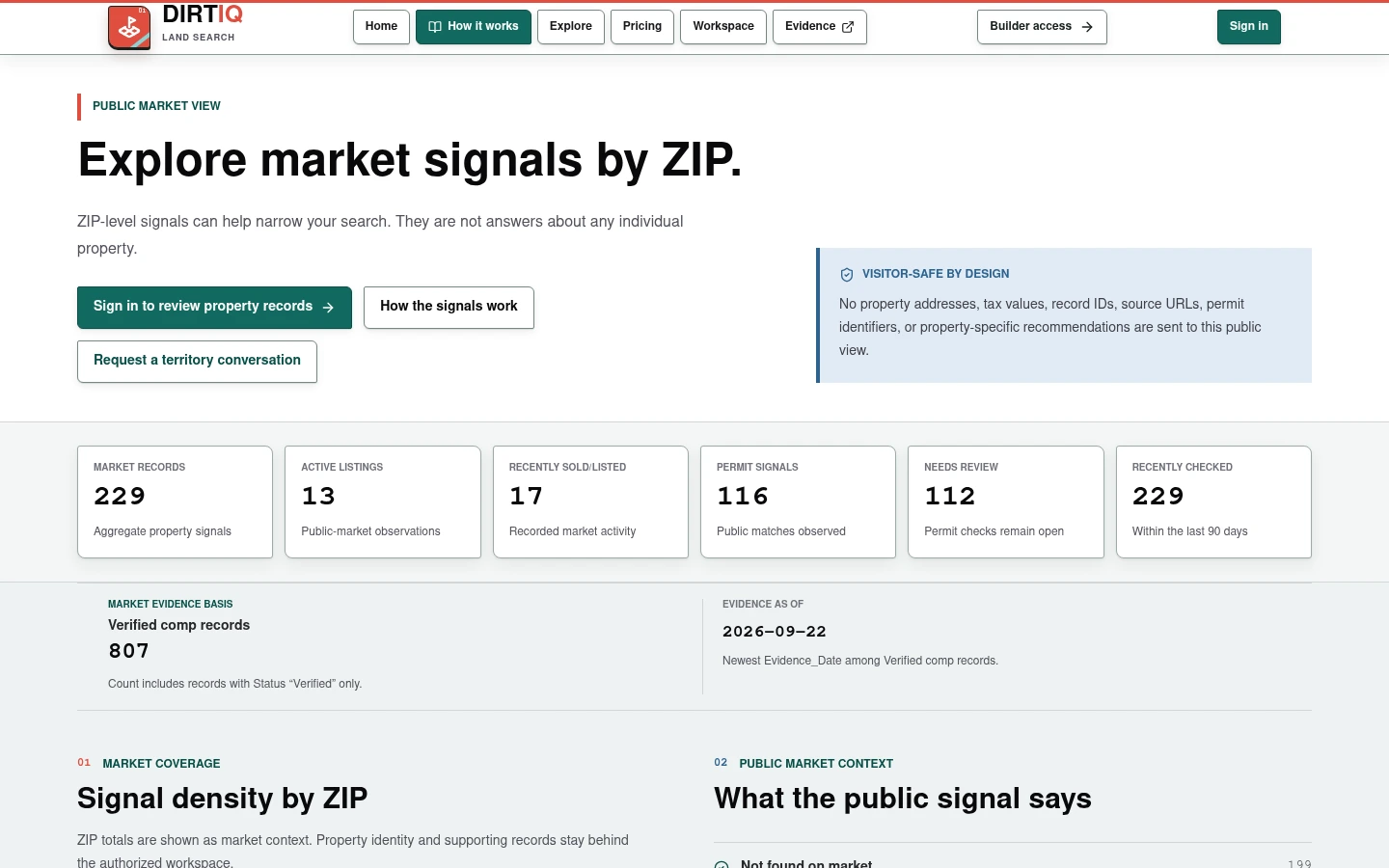
Compare aggregate listings, permits, and recorded market activity by ZIP. These signals help narrow a search; they do not answer what can be built on a specific property.
Loading page...
Preparing public signals and workspace tools.
DirtIQ for custom home builders
DirtIQ brings market discovery up front and a review workflow behind it: where to look, what supports a candidate, and what your team should do next.
An acquisition is buying land for a building project. Infill is a new home within an established neighborhood. A tear-down is an existing home considered for replacement; that label does not establish that replacement is allowed.
Compare aggregate listings, permits, and recorded market activity by ZIP. These signals help narrow a search; they do not answer what can be built on a specific property.
A buy box is the criteria your team uses to screen candidates. Save criteria such as target ZIPs, lot area, price, and intended use, then return to the same search.
Use the workspace map and property list to inspect candidates in your authorized territory. A parcel is one property under review.
A parcel is one property under review. Its shared case file holds observations, source dates, open questions, and review. Diligence means checking records, site conditions, and permissions before a purchase. Comps (comparable sales) are sales of similar properties used as reference points, not appraisals.
Keep source observations, dates, notes, and unresolved questions together. Unknown facts stay unknown until a source supports them.
Review dated sale records and permit signals as context. A permit record does not establish approval for a proposed project.
See when a check was recorded and whether its source completed, failed, or returned a dated negative finding. Recently checked describes freshness, not completeness or correctness.
Buildability asks whether a specific plan can fit the site's physical conditions and applicable rules. DirtIQ can track the question; it does not determine the answer.
Turn open questions into owned work. The workspace keeps the next action, responsible teammate, and review history with the parcel.
Assign a teammate, due date, and dependencies. Record the work completed or return an unresolved item to the queue.
A scenario is a versioned set of assumptions about costs and possible outcomes. Changes create a new review point rather than silently changing an earlier decision.
Underwriting is the team's financial review before committing to a purchase. Submit a specific scenario version for a separate review, then record whether to pursue, hold, or pass.
Evidence before estimates.
The working model is source observation, reviewed finding, then decision. An empty result, a failed source request, and a verified negative finding are different states.
Sample case file — illustrative
This workflow illustration uses only public ZIP-level aggregates. It is not a real parcel, completed review, comp, or property-specific finding.
01 · Source observation
Observed in the public ZIP explorer. The date below is the latest ZIP-level source activity available, not a parcel check date.
Latest source activity: .
ZIP-level market signals are public. Parcel records and team work stay in the authorized workspace.
Public signals outside. Private diligence inside.